
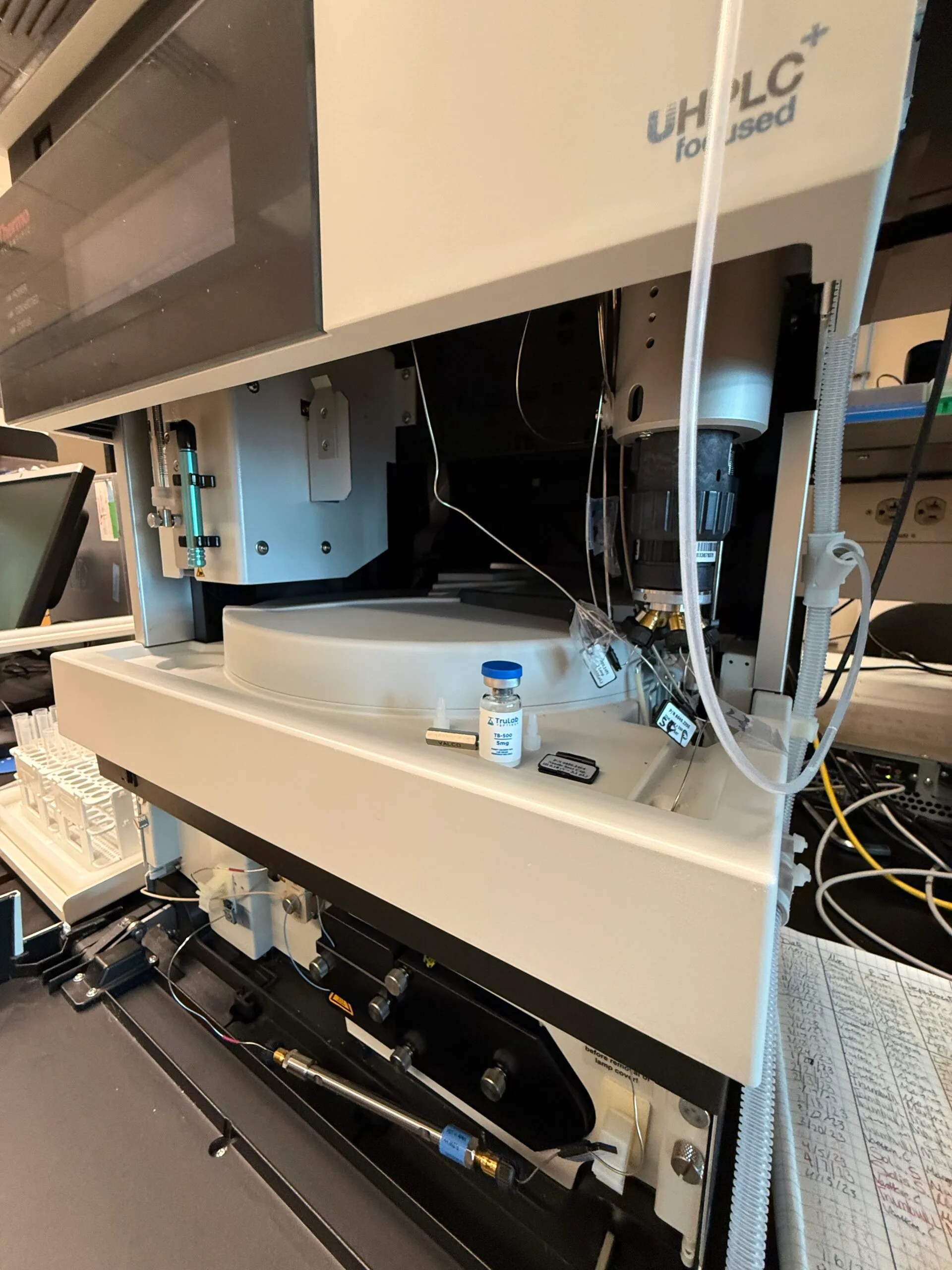
Peptide Purity Testing: The Gold Standard in Research Integrity
In the high-stakes world of laboratory research and biochemical analysis, there is no room for “close enough.” When you invest in your studies, you aren’t just buying a vial; you are buying the data that comes from it. If your peptides are compromised by contaminants, your entire project is at risk. Peptide purity testing is not just an optional service—it is a mandatory safeguard for anyone demanding elite-level precision and verifiable results.
Don’t let subpar manufacturing or “gray market” shortcuts jeopardize your reputation. Our comprehensive testing protocols provide the transparency you need to move forward with absolute confidence.
Why Peptide Purity Testing Is Non-Negotiable
The peptide industry is currently flooded with suppliers, but not all are created equal. Without rigorous HPLC and Mass Spectrometry (MS) analysis, you are essentially flying blind. Impurities in a peptide sample—such as residual solvents, TFA (Trifluoroacetic acid), or truncated sequences—can lead to toxic cellular responses or completely skewed data sets.
By utilizing professional peptide purity testing, you ensure that what is on the label is exactly what is in the vial.
The Dangers of “Budget” Peptides
The “cheaper” option often comes with a hidden cost:
-
Residual Solvents: Acetonitrile or other chemicals used in synthesis that weren’t properly removed.
-
Incorrect Sequences: Peptides that look like your target molecule but have one amino acid missing, rendering them useless.
-
Bacterial Endotoxins: Potentially dangerous contaminants that can trigger inflammatory responses in in vitro or in vivo models.
Our Testing Methodology: A Multi-Layered Approach
We utilize the most advanced analytical chemistry techniques to provide a monumental level of detail for every sample submitted.
1. High-Performance Liquid Chromatography (HPLC)
HPLC is the primary method used to determine the quantitative peptide purity testing of a peptide. This process separates the main peptide from any impurities or related substances based on their interaction with a stationary phase.
-
What it measures: The “Area Under the Curve” (AUC) percentage.
-
Our Standard: We verify if your sample meets the industry-standard $98\%$ or $99\%$ purity threshold.
2. Mass Spectrometry (MS) Analysis
While HPLC tells us how much of the substance is there, MS tells us exactly what it is. By measuring the mass-to-charge ratio of the ions, we can confirm the exact molecular weight of the peptide.
-
Confirmation: This ensures the sequence identity is correct.
-
Detection: It identifies the specific nature of any impurities present.
3. Amino Acid Analysis (AAA)
For those requiring the highest tier of validation, Amino Acid Analysis provides the exact ratio of amino acids within the peptide chain. This is the ultimate proof of correct synthesis for complex, long-chain peptide purity testing.
Understanding the “Purity Percentage”
A common misconception in the research community is that “98% Purity” means the remaining 2% is water. In reality, that 2% could be anything from harmless salts to bioactive peptide fragments that interfere with your receptors.
When we perform peptide purity testing, we provide a Certificate of Analysis (COA) that breaks down:
-
Net Peptide Content: The actual weight of the peptide minus the counter-ions and residual water.
-
Purity Level: The percentage of the target peptide relative to other peptide-like impurities.
-
Solubility Profile: Recommendations on the best buffer or solvent for reconstitution.
The Benefits of Independent Lab Verification
Absolute Peace of Mind
When you use a third-party testing service, you remove the “conflict of interest” inherent in supplier-provided COAs. You gain a fearless perspective on the quality of your materials.
Reproducible Results
Science relies on reproducibility. If your peptide purity testing fluctuates between batches, your results will too. Regular testing ensures batch-to-batch consistency, allowing you to publish data that stands up to peer review.
Protection of Biological Models
Whether you are working with cell cultures or complex biological systems, impurities can cause “off-target” effects. Professional testing prevents the accidental introduction of toxins into your sensitive environments.
How to Submit a Sample for Testing
Our process is designed for speed and accuracy, ensuring your research isn’t delayed.
-
Submission: Securely package $5mg$ to $10mg$ of your lyophilized peptide.
-
Analysis: Our lab technicians run the HPLC and MS protocols within 48-72 hours.
-
Reporting: You receive a digital, high-resolution report featuring the chromatogram and mass spec data.
Technical Data: The Math of Purity
We calculate purity using the following simplified relation:
This ensures that even the smallest “shoulder peaks” are accounted for in the final assessment.
Stop Guessing. Start Testing.
The difference between a breakthrough and a failure often comes down to the quality of your reagents. In a world of obscured labels and inconsistent manufacturing, peptide purity testing is your only true shield. Demand the data, verify your vials, and ensure your research is built on a foundation of monumental quality.
Don’t let a single impure vial ruin years of hard work. Invest in the gold standard of verification today.
Be the first to review “peptide purity testing”
Related products
Metabolic Research
Metabolic Research
Metabolic Research
Metabolic Research
Reviews
There are no reviews yet.